In six months, I delivered an AR exhibition that extended Bozar into the streets of Brussels; including a sponsorship model where the sponsor's own building became the artwork.
Result: +25% visitors under 30, +40% social engagement, 2,000+ downloads, and international trade press.
Role: Product lead, Bozar (Centre for Fine Arts, Brussels)
Owned: Product concept · Business case & sponsor model · Vendor selection (public tender) · Research & user studies · Wireframes · Delivery coordination · Usability testing · Post-launch iteration
Team: Bozar curatorial, exhibitions & communications teams · 5 commissioned artists · Tropos AR (external development studio)
Timeline: Ideation & procurement from Oct 2023 · Public launch late Feb 2024 · Ran to mid-June 2024
Live: Press: MuseumNext · Presented at Museum XR Summit 2024

The brief
Six months before Bozar’s major Belgian Surrealism exhibition, I was asked to build a digital layer around it.
The business problem wasn’t “add technology.” It was the audience. The exhibition was historic work for an audience that already comes to museums. Leadership wanted to reach a younger, digital-native public.
The concept and the business model inside it
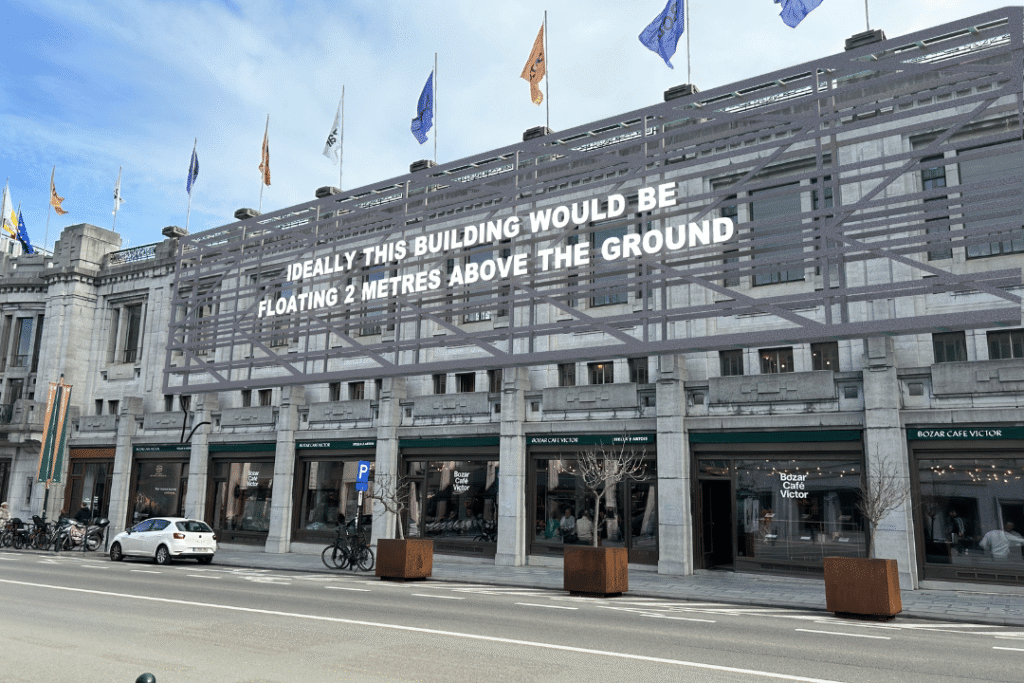
My proposal was to take the exhibition out of the building: artworks appearing in augmented reality on the façades and open spaces around the Mont des Arts, connecting the fabric of the city to what was happening inside Bozar via an app.
The medium fit the message: AR makes impossible things appear in ordinary places, which is roughly Surrealism’s job description. The title was borrowed from Magritte’s most famous joke.
But the concept was also a funding strategy. If artworks hang on buildings, whose buildings becomes a commercial decision. I proposed anchoring works to the façades of potential corporate sponsors, so sponsorship was structural to the artwork.
Bozar’s neighbouring bank, BNP Paribas Fortis, came in with an artwork hanging in AR from its façade. I then designed their visibility through the whole experience:
- AR artwork on the BNP Paribas Fortis façade
- Physical info walls at BNP Paribas Fortis, and one in Bozar’s Horta Hall credited to them
- In-app logo placement and a CEO quote on innovation
- A joint communications campaign
- A surrealist twist on their own signage — the info wall read “ceci n’est pas un BANQUIER”, making the sponsor a participant in the joke rather than an advertiser interrupting it
That last detail is how the model worked in both directions: sellable to a bank, tolerable to artists.
Vendor selection under procurement
The tradeoff I made: I chose a studio with solid technical capability and the ability to deliver on a compressed timeline, over more artistically sophisticated candidates. Given six months and a budget a third of the market quote, delivery capacity was the constraint.
What it cost: technical stability. The studio met the deadline but not our expectations, and platform instability became our biggest post-launch problem.
Building the product
Five artists were commissioned to choose a location around Bozar and create a poetic, text-based work that could float in the air: Annabelle Binnerts, Ghita Skali & Salim Bayri, Laure Prouvost, Valérie Mréjen. The studio handled 3D creation, animation, and GPS/VPS anchoring.
I acted as the mediator between artists and developers, making sure the creative vision survived contact with technical reality.
An unbudgeted discovery: the artists were largely unfamiliar with AR as a medium. They needed more support than the plan assumed.
Internally, an invisible artistic platform has an obvious marketing problem: nobody can see it. I worked closely with the communications team on wild postering and a social campaign.
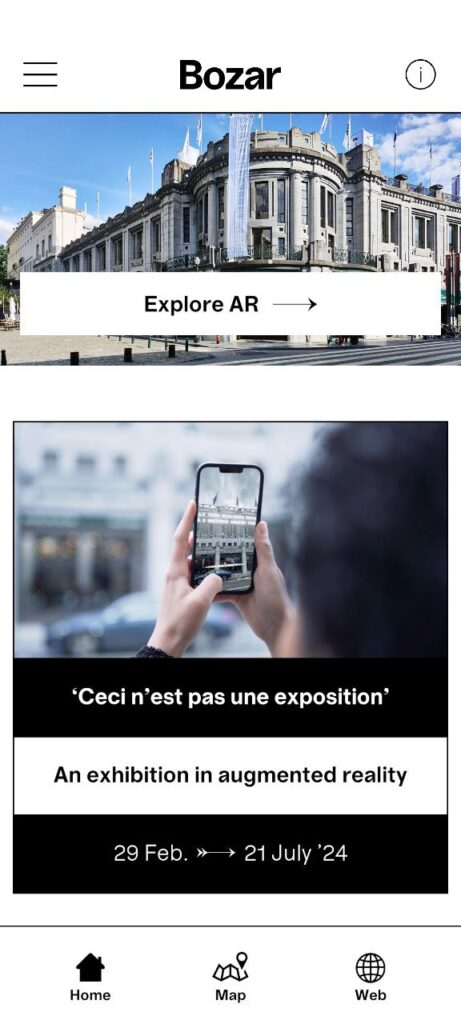
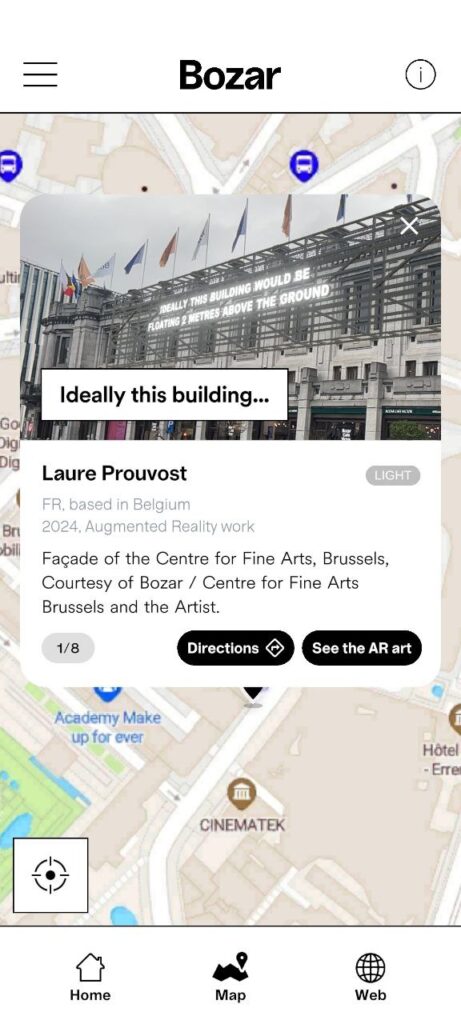
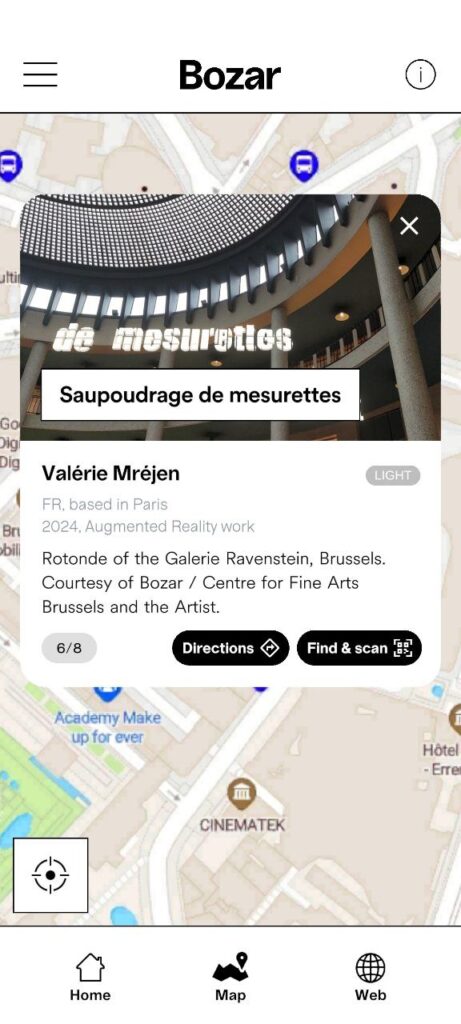
Research
I ran user interviews and observational studies, walking with users through the entire journey: discovering the app, downloading it, then standing in a public square trying to find an artwork that exists only through their phone.
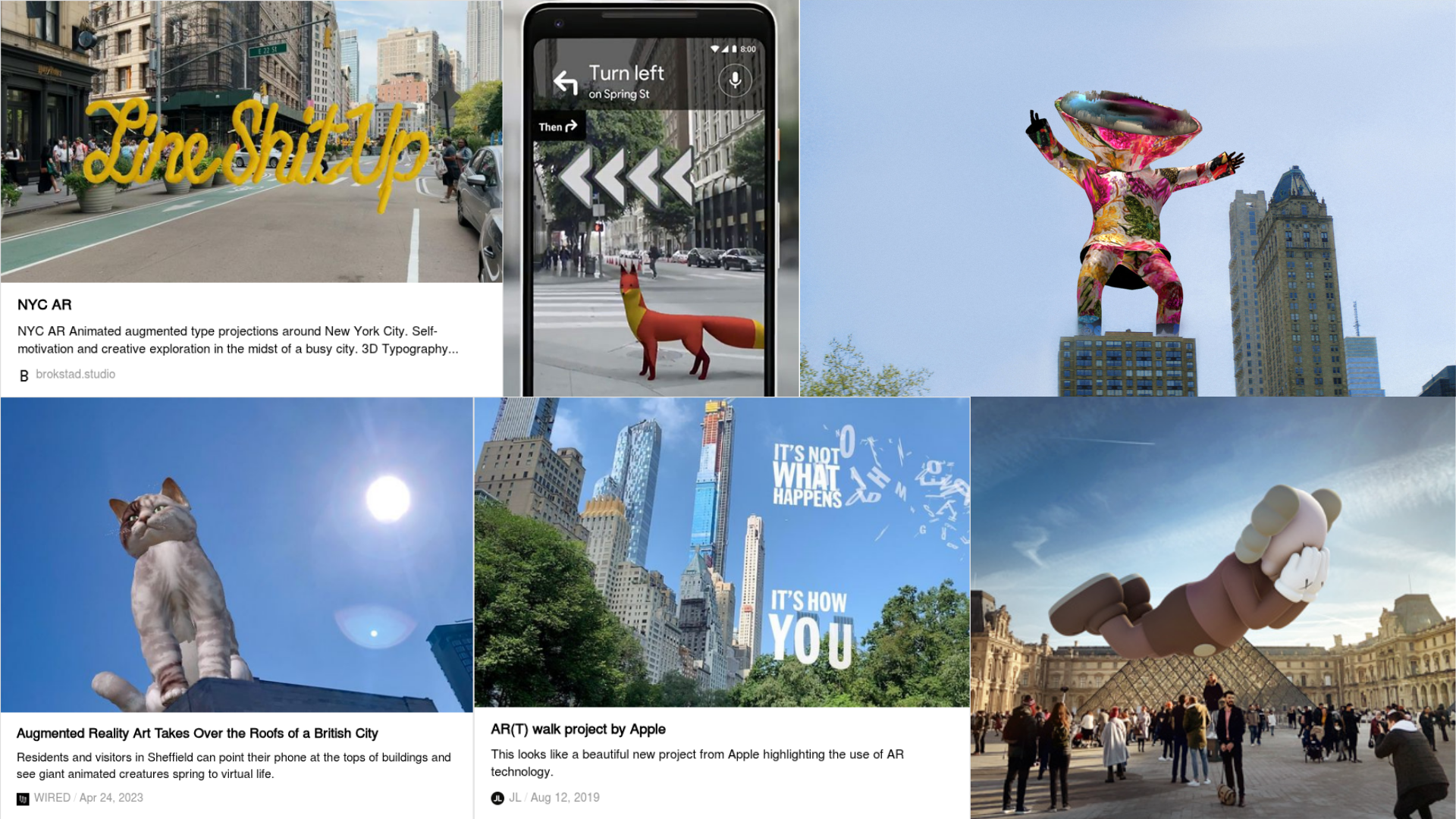
An important decision for the project: GPS vs. markers
We built on GPS/VPS location anchoring, which made works appear when you’re in the right place. Then some artists chose indoor locations, where location anchoring doesn’t work reliably.
The studio proposed the clean fix: switch to marker-based AR. Scan a QR code, get the artwork. Reliable, consistent, cheap.
I pushed back and kept it location-based.
Marker-based AR solves the technical problem by dissolving the product. The concept rested on art appearing on real buildings in public space. A QR code is not a surrealist encounter; it’s a museum label. It would also have destroyed the sponsor model: you cannot sell “your façade becomes an artwork” if the artwork only exists beside a printed sticker.
We shipped a dual-mode system: GPS-anchored works outdoors, QR-triggered works indoors, all in one app.

Launch, and the work after launch
We launched on a tight deadline, and the honest assessment is that the platform wasn’t ready. What broke:
- Unstable AR anchoring
- Device incompatibility
- Mode confusion — the GPS/QR
Iteration ran continuously from launch to June. Driven by watching users:
- Reference images of each artwork so people knew what to look for, because it converted invisible failure into a solvable search
- Explicit distinction between GPS and QR-based works
- An intro video building the mental model before the user is alone in a square
- Proximity guidance and map navigation (“You are 3.1km away from AR art”)
- Ongoing debugging of anchoring and device support
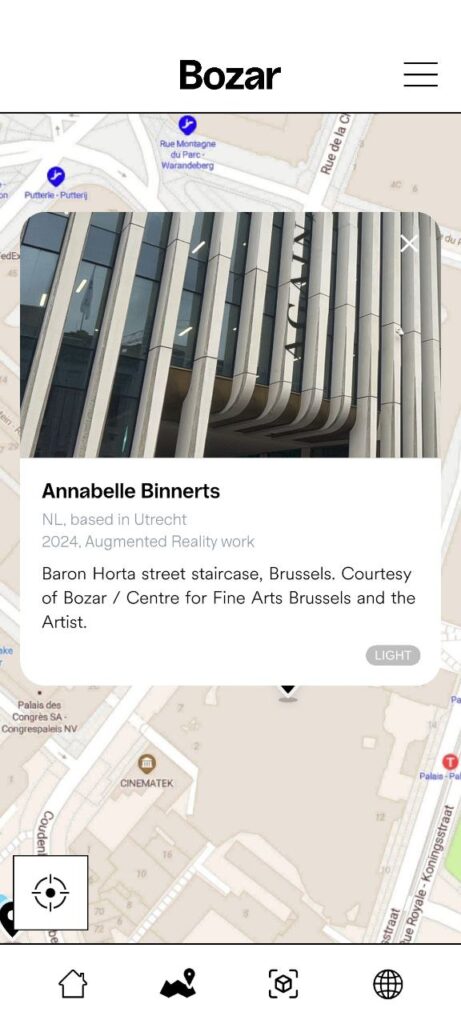
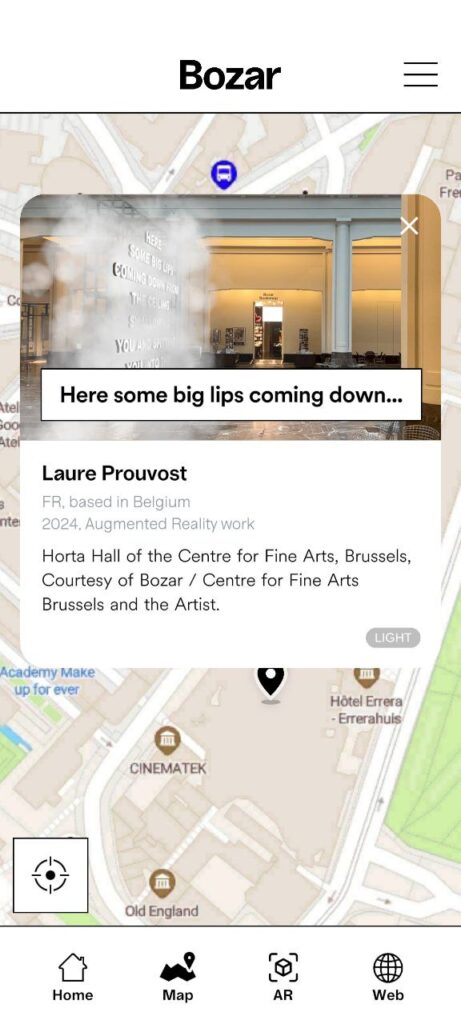
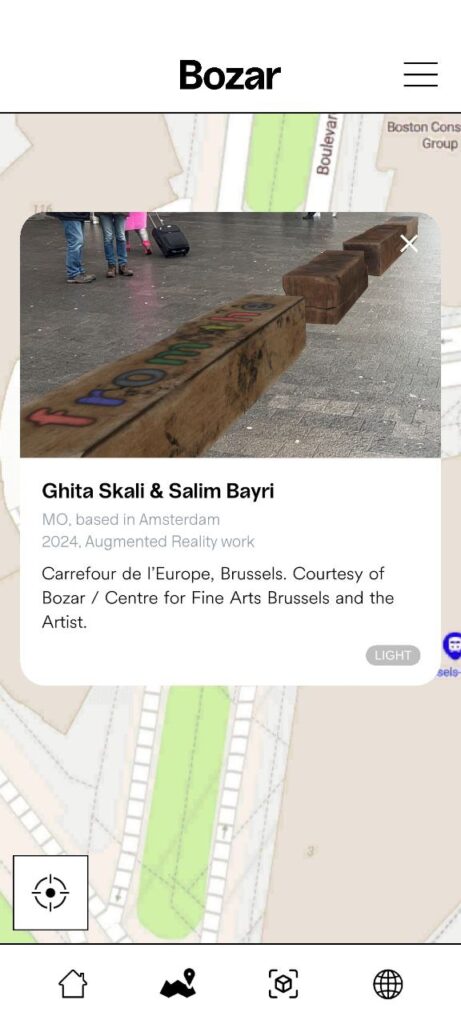
Results
| Unique visits to AR artworks | 1,954 |
| App downloads | 2,000+ (1,225 iOS, 800+ Android) |
| Social media interactions | +40%, largely user-generated content of the works |
| Visitors under 30 | +25%, the demographic the project was commissioned to reach |
| Sponsorship secured | Corporate sponsorship secured from BNP Paribas Fortis |
| Recognition | International & local coverage |
Scope was deliberately modest. It hit its stated audience objective, and once people found the works, they became the campaign: shared experiences drove organic reach the media budget couldn’t have bought.
Retrospective
The idea was strong on paper; the execution was constrained by an immature technology, a compressed timeline, and a vendor that couldn’t fully meet expectations. Four things I took from it:
Match scope. Within six months, the responsible move was to execute fewer artworks reliably. I accepted the full scope and paid for it in stability. That’s the decision I’d most want back.
Defending the concept is the job. Refusing the marker-based shortcut was right, but defending a concept has a cost, and it should be planned for rather than absorbed as a surprise.
With unfamiliar technology, onboarding is the product. We spent our design effort on the AR. The users’ problem was never the AR; it was not knowing what the app wanted from them.
Mobile is the wrong platform for AR. People hold a phone to look at a screen, not through it at the world. AR belongs in glasses, where the interaction grammar is native rather than borrowed.
I lead digital products that combine technology, human behavior, and experience innovation.